

Weathering With Microclimates | Embodiment Workshop
Festival Beach Food Forest, Austin, with community participants and architecture students at the University of Texas at Austin
Workshop co-created with Cathryn Ploehn
Overview
How might we engage extreme heat as a lived, uneven condition rather than an abstract environmental metric? Weathering With Microclimates invited participants to experience heat through embodied movement across contrasting outdoor microclimates shaped by shade, vegetation, soil, and material conditions. Through guided movement, fabulation, and environmental sensing, the workshop foregrounded how heat is felt, negotiated, and interpreted through bodies in motion. Held at an outdoor site with varied microclimatic zones, the session aimed to cultivate attunement to environmental differences and explore relationships between measured conditions and lived experience.
Workshop Flow
1. Framing & Orientation
Participants were introduced to extreme heat, microclimates, and environmental sensing to establish a shared conceptual frame for the workshop.
2. Initial Fabulation
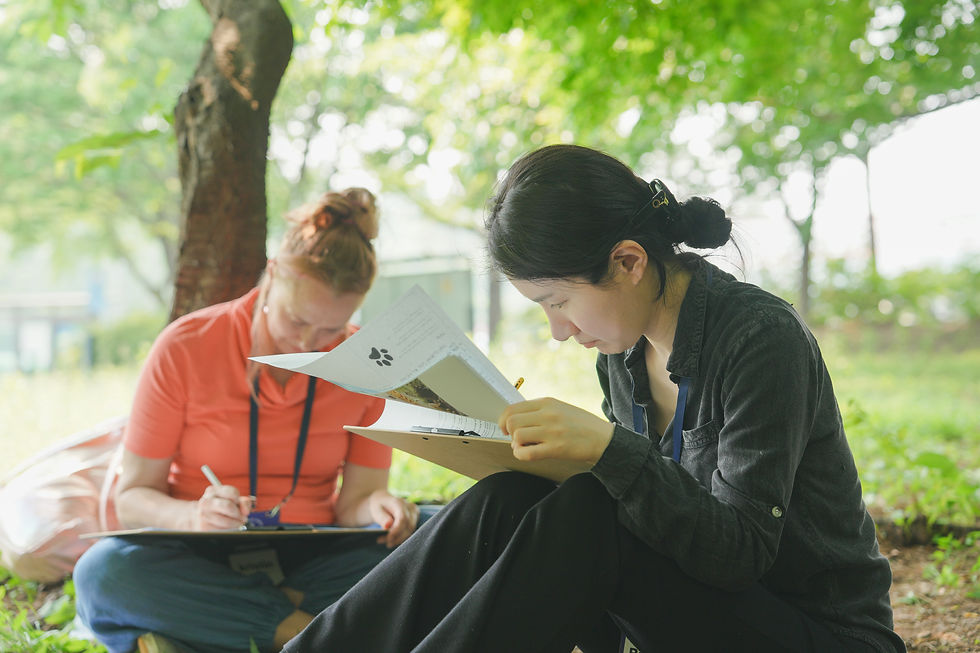
Participants responded to short written and drawn prompts to capture baseline interpretations of heat, comfort, and exposure prior to bodily engagement.
3. Embodied Microclimate Walk
Participants moved sequentially through three proximate outdoor zones, densely vegetated shade, open exposed ground, and a transitional mixed area, attending to sensations such as warmth, strain, airflow, surface temperature, and fatigue through guided sensory tasks. Repeating prompts across zones foregrounded contrast and micro-variation.
4. Reflective Re-fabulation
Participants revisited the same prompts to document shifts in attention, language, and interpretation following embodied exposure.
5. Sensor Dialogue & Discussion
Summarized microclimate sensor data (temperature, humidity, heat index) were introduced, prompting discussion around alignments and divergences between measured conditions and bodily experience.
Outcomes
Participants shifted from describing heat as a generalized condition to articulating localized, relational differences shaped by movement, materials, and vegetation. The workshop surfaced embodied ways of knowing that complemented quantitative sensing, revealing climate engagement as an ongoing process of weathering-with across human, ecological, and technical systems.
Through this workshop, I observed how embodied movement reshaped participants’ perception of space and design. Simple acts like slowing down, sniffing, or adjusting one’s gait heightened attention to environmental cues often overlooked in conventional design processes. Yet embodiment alone wasn’t enough—structured reflection and design prompts were essential to help students translate these sensory experiences into thoughtful design strategies. I also noticed how playfulness and openness—especially in a supportive setting like the farm—encouraged deeper engagement and creativity. Importantly, this process isn’t about mimicking another species, but about fostering a more attentive, humble way of perceiving the world. Multispecies design is not about designing for animals in an anthropocentric way, but rather about designing with an awareness of their sensory experiences and needs.
Through this workshop, I observed how embodied movement reshaped participants’ perception of space and design. Simple acts like slowing down, sniffing, or adjusting one’s gait heightened attention to environmental cues often overlooked in conventional design processes. Yet embodiment alone wasn’t enough—structured reflection and design prompts were essential to help students translate these sensory experiences into thoughtful design strategies. I also noticed how playfulness and openness—especially in a supportive setting like the farm—encouraged deeper engagement and creativity. Importantly, this process isn’t about mimicking another species, but about fostering a more attentive, humble way of perceiving the world. Multispecies design is not about designing for animals in an anthropocentric way, but rather about designing with an awareness of their sensory experiences and needs.

Participants begin a guided attunement exercise, sensing shade, airflow, and temperature differences through collective movement.
Temperature, humidity, and heat index data from three locations are introduced, prompting dialogue between quantitative sensing and lived bodily experience.

After moving through the environments, participants revisit earlier prompts to document shifts in perception, language, and spatial awareness.

Guided movement exercises invite participants to sense airflow, shade, surface temperature, and bodily effort across contrasting outdoor conditions.


Participants collectively pour water across shaded, exposed, and transitional areas to reveal microclimatic differences through evaporation, touch, and observation.


Guided movement exercises began with a brief warm-up to attune participants to their bodies and surroundings.


Participants begin with short drawing and writing prompts to map their assumptions about heat, comfort, and exposure before bodily engagement.