

Exploring a Pigeon's Umwelt | Designing for Coexistence
UT Austin Campus (Visual Arts Center Area) — with interdisciplinary design students
Overview
How might we design with pigeons in mind, rather than against them?
This workshop invited design students to explore the perceptual and behavioral world (Umwelt) of pigeons through embodied movement, sensory constraints, and iterative design exercises. Situated in an urban environment where pigeons are often ignored or treated as nuisances, the session aimed to shift perception, from pest control toward coexistence, and to inspire interventions that support pigeons as active urban inhabitants.
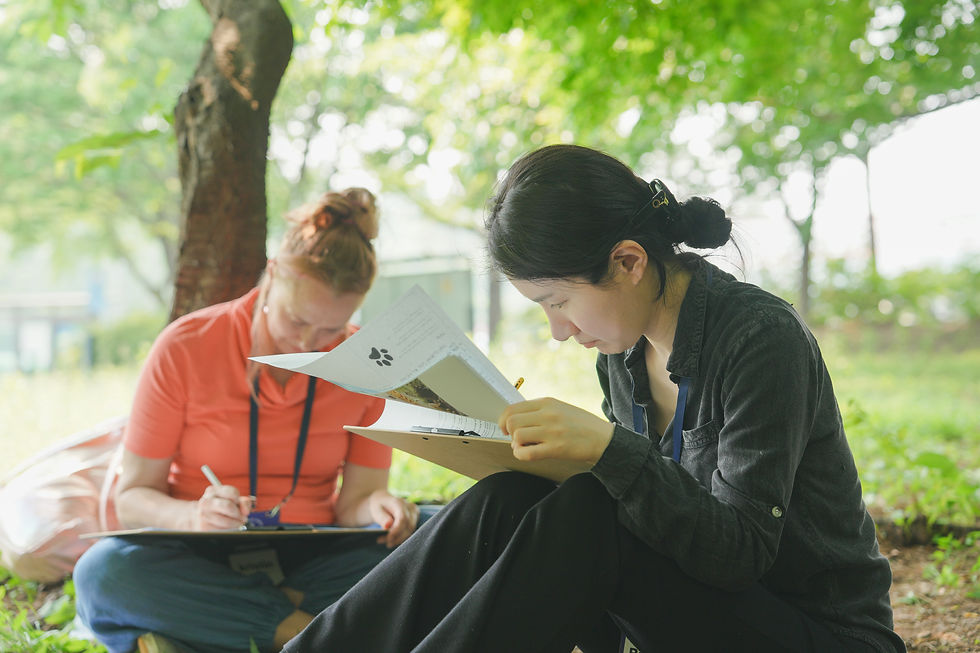
Through this workshop, I observed how embodied movement reshaped participants’ perception of space and design. Simple acts like slowing down, sniffing, or adjusting one’s gait heightened attention to environmental cues often overlooked in conventional design processes. Yet embodiment alone wasn’t enough—structured reflection and design prompts were essential to help students translate these sensory experiences into thoughtful design strategies. I also noticed how playfulness and openness—especially in a supportive setting like the farm—encouraged deeper engagement and creativity. Importantly, this process isn’t about mimicking another species, but about fostering a more attentive, humble way of perceiving the world. Multispecies design is not about designing for animals in an anthropocentric way, but rather about designing with an awareness of their sensory experiences and needs.
Through this workshop, I observed how embodied movement reshaped participants’ perception of space and design. Simple acts like slowing down, sniffing, or adjusting one’s gait heightened attention to environmental cues often overlooked in conventional design processes. Yet embodiment alone wasn’t enough—structured reflection and design prompts were essential to help students translate these sensory experiences into thoughtful design strategies. I also noticed how playfulness and openness—especially in a supportive setting like the farm—encouraged deeper engagement and creativity. Importantly, this process isn’t about mimicking another species, but about fostering a more attentive, humble way of perceiving the world. Multispecies design is not about designing for animals in an anthropocentric way, but rather about designing with an awareness of their sensory experiences and needs.
Finally
Design Evolution (Selected Examples)
Material Dispenser → Communal Urban Roost
Shifted from a controlled resource distribution system to a layered, multispecies habitat supporting resting, nesting, and social interaction.
Window Nesting Box → Urban Sanctuary
Evolved from a human-centered observation device into a larger, semi-autonomous habitat prioritizing pigeon comfort, privacy, and ecological integration.

The workshop was structured in four main phases: an initial design brief, embodiment through sensory tools, a guided movement session, and a final reflection and redesign.
Movement Session
Participants engaged in a sequence of embodied prompts reflecting pigeon behavior and perception:


Observation Walk
Attuning to pigeon movement, rhythms, and urban conditions

Initial Design Brief
Students developed early concepts for pigeon-inclusive urban interventions—often focusing on containment, feeding control, or aesthetic integration within human environments.
Embodiment Tools
Beak prosthetics, limiting hand-based interaction and redirecting attention to pecking and head-based engagement
Structured design sheets supporting translation from embodied experience to design through prompts such as:
Purpose (from the pigeon’s perspective)
Location (urban environments)
Features (behavioral and sensory affordances) Materials (durability, tactility, environmental fit)
Variations (adaptability across contexts)


Flocking coordination
Moving collectively, negotiating proximity and spacing

Foraging and pecking
Interacting with the ground using head-led movement


Perching and Scanning
Occupying elevated surfaces while maintaining vigilance


Threat response exercises
Reacting to simulated urban dangers (noise, humans, predators) through freeze or flight


These activities emphasized pigeons’ constant negotiation between safety, sociality, and resource access in dense urban environments.


Reflection & Redesign
Following the movement session, students revisited their designs—shifting from human-centered control systems to proposals that support:
-
Social and communal behaviors (roosting, flocking)
-
Sensory-based navigation (visibility, safety, spatial awareness)
-
Habitat integration within existing urban infrastructures
-
Reduced human interference and increased animal autonomy